Sidecar
Cognac, Cointreau, and lemon. Pre-Prohibition in one glass.
The Sidecar emerged in Paris and London in the years just after World War One, appearing in print in Robert Vermiere's Cocktails: How to Mix Them (1922) and Harry MacElhone's Harry's ABC of Mixing Cocktails (1923). Both credited different bartenders -- MacElhone claimed a Pat MacGarry at Buck's Club in London, others pointed to Harry's New York Bar in Paris -- and the origin remains genuinely contested. What is certain is the template: a spirit, an orange liqueur, and a citrus juice in proportions that produce something tart and balanced. The Daisy family, which the Sidecar belongs to, established the framework that later gave us the Margarita, the Cosmopolitan, and dozens of other sour cocktails built on the same bones.
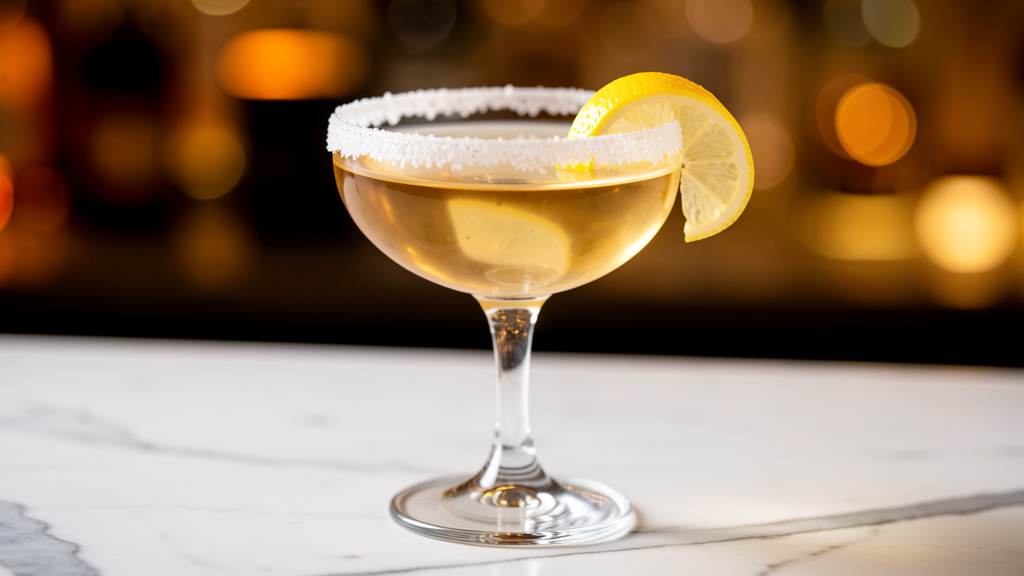
The sugar rim is traditional and functional -- it softens the first sip and evolves through the glass as it dissolves into the drink. The Sidecar is short and cold and direct. It does not linger the way a stirred cocktail does, but it is precise in the way that only a well-calibrated sour can be.
Single Serve
Shaken to order. Not batchable due to fresh lemon. The 2:1:1 ratio (Cognac:Cointreau:lemon) is the classic spec. Some prefer 2:1:0.75 for a slightly drier finish.
Notes on the Spec
The double strain keeps ice chips and any lemon pulp out of the coupe. The glass should be very cold -- chill it in the freezer for 5 minutes before serving. The Sidecar is small and warms quickly; cold glass extends the window.
The half sugar rim is deliberate. A full rim forces sweetness on every sip. A half rim lets the drinker choose -- sweet side for the first sip, unsugared side when the tart becomes the point.
What Each Ingredient Brings
VS is fine for daily use. VSOP adds stone fruit depth -- dried apricot, a little oak -- that elevates the drink noticeably. The Cognac is the primary flavor vehicle; everything else is calibrating around it. Use something you would sip on its own.
Armagnac works as a sub -- earthier, more rustic character. Changes the register of the drink without breaking the template.
Not interchangeable with generic triple sec. Cointreau uses a cold maceration of bitter and sweet orange peels and has a clean, high-proof orange oil character that cheap triple sec lacks. The orange note in the Sidecar should read as bright and aromatic, not sweet and artificial.
Grand Marnier works as a sub and adds Cognac-based depth. Changes the texture slightly -- richer and slightly sweeter.
The acid backbone. Squeezed to order -- oxidized or bottled lemon juice is visibly different in a drink this simple. There is nowhere to hide. Squeeze it within 30 minutes of serving.
The 0.75 oz spec is the classic. If your lemons are very tart, 0.5 oz produces a slightly richer result. Taste the lemon before you commit.
Traditional and functional. The first sip hits the sugared rim and reads sweet-then-tart. As you drink, the sugar dissolves into the cocktail and slowly sweetens the remaining liquid. It is a textural arc, not decoration.
Half-rim only. A full sugar rim is aggressive and removes the drinker's choice.
Flavor Arc
The Daisy Template
The Sidecar belongs to the Daisy family: a base spirit, an orange liqueur, and citrus in roughly 2:1:1 proportions. The template is one of the most durable in cocktail history.
The Margarita is a Daisy with Tequila and lime. The Cosmopolitan is a Daisy with vodka, Cointreau, cranberry, and lime. The White Lady is a Daisy with gin. Understanding the Sidecar means understanding why all of those drinks work.
First published by Robert Vermiere, Cocktails: How to Mix Them (1922) and Harry MacElhone, Harry's ABC of Mixing Cocktails (1923). Origin contested between Buck's Club, London and Harry's New York Bar, Paris.