 James Davis
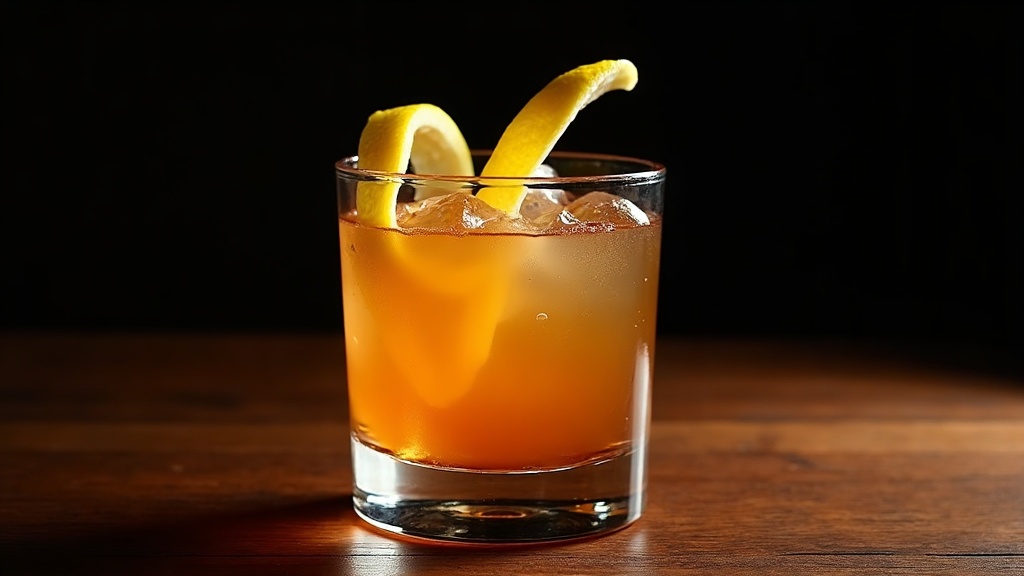
Peach Brandy Sazerac
New Orleans's oldest cocktail, rebuilt around a single-source Georgia peach brandy aged in bourbon barrels.
Recipe by Miles Macquarrie, Kimball House, Decatur, Georgia.
The Sazerac is the oldest named cocktail in America with a credible continuous history. It was born in New Orleans in the 1830s, originally made with Sazerac-de-Forge et Fils cognac, Peychaud's bitters (invented by Antoine Amedie Peychaud, a Creole apothecary), and absinthe as a rinse. When phylloxera devastated French vineyards in the 1870s and cognac became scarce, American rye whiskey stepped in and stuck.
The modern canonical Sazerac is rye (Rittenhouse 100 proof being the bar standard), Peychaud's, a dash of Angostura, sugar, and an absinthe-rinsed glass. It is a stirred, spirit-forward drink that asks you to pay close attention.
Miles Macquarrie's Peach Brandy Sazerac at Kimball House replaces rye with something more specifically Southern: High Wire Distilling's bottled-in-bond peach brandy, distilled September 8, 2021, from a single variety of July Prince peaches grown at Titan Farms in Ridge Spring, South Carolina. Aged four years in Jimmy Red bourbon barrels and bottled at 100 proof (267 of 491 bottles). This is a brandy with a biography.
The effect is a Sazerac that retains all the structural integrity of the original, with the absinthe rinse, the Peychaud's, the sugar, and the stirred concentration, but whose base spirit tells a story about Georgia and South Carolina peaches rather than Louisiana rye fields. It's historically aware and deliberately local at the same time.
Single Serve
Steps
Gomme Syrup
Gomme syrup (from the French gomme arabique, gum arabic) is the sweetener used in 19th-century cocktail bars before simple syrup became the standard. Gum arabic is a natural emulsifier derived from acacia tree sap; it gives the syrup a silky, almost creamy mouthfeel that plain sugar syrup lacks. This is what a proper pre-Prohibition Sazerac would have used.
Gum solution: In a blender on low speed, slowly pour 250g boiling water. With the blender still running, very slowly sift in gum arabic and xanthan gum. This takes patience; rushing causes clumping. The mixture should become smooth and viscous.
Syrup: Add both sugars and remaining 1000g boiling water to the blender. Increase speed until fully dissolved and uniform. Cool before bottling.
Home simplification: a 2:1 simple syrup (2 parts sugar, 1 part water by weight) works fine. Add 0.5% xanthan gum if you want the mouthfeel without sourcing gum arabic. Still excellent.