Navy Strength Gin · Scuppernong Cordial · Muscadine Wine · Lemon · Luxardo Bitter Bianco
Recipe by Miles Macquarrie / @lois_must_die, Kimball House, Atlanta
The Enzoni is a classic from Vincenzo Errico at Milk & Honey New York, circa 2003: a Campari sour with grapes. Macquarrie's Bianco version keeps the structure (gin, bitter, citrus, grape) and translates it into the Georgia terroir: scuppernong cordial from the native Southeastern muscadine grape, muscadine wine in place of Campari's red fruit, and Luxardo Bitter Bianco's white bitter notes replacing the red bitter. The result is a brighter, more specifically Southern riff on an already great drink.
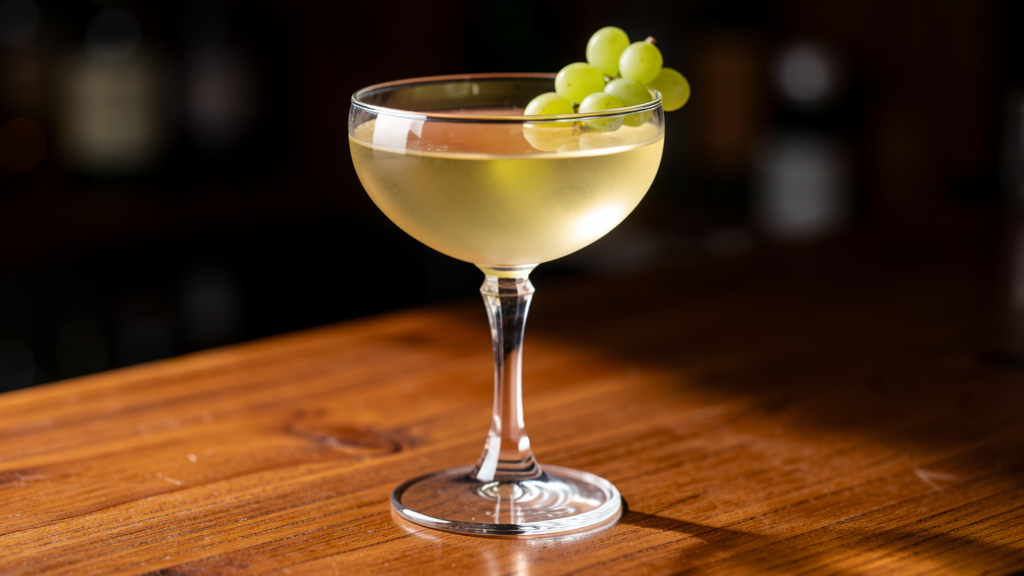
This is one of the few Kimball House drinks that benefits from shaking rather than stirring at service. The lemon juice needs aeration. Keep the batch cold and fresh. The scuppernong cordial has a mild funkiness from the grape skin that integrates beautifully with the navy strength gin over a few hours of rest.
Scuppernong grapes are available at Georgia farmers markets and some grocery stores in late summer (August–September). If unavailable, a good quality Concord grape or any muscadine variety can substitute, though the flavor will be different. Yield: approximately 500ml.
The original Enzoni was built on a simple observation: the Negroni's gin-Campari-vermouth structure could absorb muddled grapes beautifully, producing something between a sour and a Negroni in weight and character. Vincenzo Errico's 2003 creation at Milk & Honey became one of the defining cocktails of the early craft cocktail era in New York.
Macquarrie's Bianco version asks a different question: what if the grapes weren't imported Italian varietals but the native grape of the American Southeast? The scuppernong is a cultivar of the muscadine grape (Vitis rotundifolia), a species native to the Southeastern United States, not the European Vitis vinifera that produces most wine grapes. Scuppernong has been cultivated in Georgia and the Carolinas since at least the 16th century. It has a distinctive flavor profile: musky, earthy, with notes of fresh grape skin and a mild funkiness that no other grape produces.
Using scuppernong cordial and muscadine wine instead of imported red fruit ingredients makes the Enzoni Bianco a specifically Southern drink in a way that goes beyond ingredient sourcing. The muscadine grape is a native species, and its presence in the drink is a form of terroir.
Navy strength refers to gin bottled at 57% ABV, the historical proof at which gunpowder would still ignite if the spirit was spilled on it. This was how the British Royal Navy verified proof on board ships. Modern navy strength gins include Plymouth Navy Strength and Perry's Tot.
The high proof is functional, not decorative. With a cordial, wine, lemon juice, and liqueur all in the drink, a standard 40% gin would get lost. The 57% holds the spirit's voice throughout the dilution.
A sweetened syrup made from Georgia scuppernong grapes, a bronze-skinned muscadine cultivar. The cordial preserves the grape's distinctive musky, earthy character in a form that integrates into cocktails cleanly.
The terroir ingredient. Nothing else tastes like scuppernong. Its inclusion makes the drink irreducibly Southern in a way that substituting any other grape flavor would undo.
Wine produced from Vitis rotundifolia, the native Southeastern grape species. Muscadine wine has a very different flavor profile from European wine: earthier, funkier, with a distinctive musky aroma and natural sweetness even in dry versions.
The structural grape element. Where the cordial provides concentrated sweetness and aroma, the wine provides volume, tannins, and a different dimension of the muscadine flavor.
An Italian aperitivo bitter made without the red coloring agents found in Campari or Aperol. Flavor-wise it's in the same family: citrus, gentian, botanical bitterness, but presented as a clear spirit, allowing the other ingredients' colors to show through.
The Campari replacement. Using the Bianco version rather than red Campari is what allows the drink's golden-amber color to come from the scuppernong and muscadine rather than being washed out by red dye.
Substitute Campari for the Luxardo Bitter Bianco and any good red grape for the scuppernong. This is the 2003 Milk & Honey original in rough form, a useful reference point.
Redder, heavier, more Italian in character. A good way to taste the difference the terroir substitution makes.
Replace half the gin with a light reposado mezcal. The smoke and the muscadine earthiness have an unexpected affinity.
Smokier and earthier. Loses the clean botanical gin quality but gains a Southern-campfire dimension.
Build single serve as written but pour over ice in a highball and top with 2 oz dry sparkling wine.
Longer, more aperitivo-appropriate. Good for warm weather serving.
The Enzoni Bianco is what happens when a New York classic gets translated into a Southern language. The grammar is the same. The vocabulary is entirely different.
 James Davis